Selected workCase studyEmbedded finance · BaaS

Productfy.

Productfy was building the "Shopify of embedded finance" — APIs and a white-label platform that let any company launch a bank account, debit card, KYC flow, and ACH movement in under three weeks. The product was real. The story wasn't yet. Our job was to design every surface that turned the platform into something a fintech founder, a community-bank exec, and an end-customer could each pick up and trust.

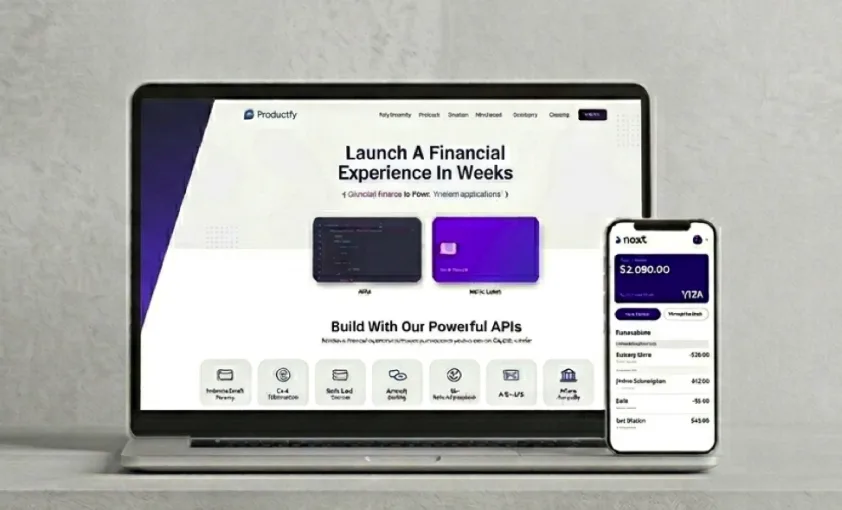
Productfy marketing site — 'Launch A Financial Experience In Weeks' with side-by-side APIs and White Label callouts.

01 · The Productfy marketing surface — Embedded Finance for 'NextGen Applications'.

(01)Challenge & scope

Challenge & scope

Banking-as-a-Service is a complicated category. The buyer might be a fintech founder hunting APIs, a community-bank chief operating officer looking for a sponsor program, or a real-estate or insurance company stitching financial primitives into a non-financial product. Each of those buyers reads a very different page.

Productfy had built the rails. What they needed was the surface — a marketing story that could speak to all three audiences at once, a white-label package customers could put their own brand on without writing a line of code, an admin console for their own ops team, and a credible demo product that proved the "launch in three weeks" claim. We took on the whole stack.
(02)Design lifecycle

Design lifecycle

Six overlapping phases stretched across ten months. Discovery dominated the first half — BaaS is one of those categories where if you don't understand the buyer's mental model, you ship a site full of right-sounding sentences that convert nobody.

  1. Phase 01 · Strategy

    Strategy

    Founder and leadership interviews. We mapped the three buyer personas — fintech founder, community-bank exec, embedded brand — and the wedge each one had to feel in the first thirty seconds on the site.

  2. Phase 02 · Research

    Research

    Competitive scan across the BaaS landscape — Galileo, Synapse, Marqeta, Stripe Treasury. Identified the gap Productfy could credibly own: deep API plus zero-code white-label, in the same product.

  3. Phase 03 · Experience mapping

    Experience mapping

    Mapped the full lifecycle: prospect → onboard → KYC → product launch → live ops. Each step got its own surface, and each surface knew exactly who it was talking to.

  4. Phase 04 · User testing

    User testing

    Concept-tested the white-label flows with real prospective customers — small fintechs, community banks, a real-estate platform stitching deposits into their tenant portal. Cut the steps that lost them.

  5. Phase 05 · Design

    Design

    Wireframes to fidelity across every surface. The admin console got the most rounds — it's the surface Productfy's own ops team would live in every day, and every defect there compounded across every customer launch.

  6. Phase 06 · Implementation

    Implementation

    Worked alongside engineering through the Series A milestone push. Shipped in waves so the marketing story landed first and the white-label tooling followed close behind — minimum daylight between the promise and the delivery.

(03)Iterate, test, repeat

Iterate, test, repeat

— Concept-tested with

01 / Founders

Fintech founders

Operators who had just decided their next product needed embedded finance — and wanted to compare us to building it themselves.

02 / Banks

Community-bank product owners

Sponsor-bank executives evaluating BaaS partnership programs and the regulatory exposure that came with each one.

03 / Brands

Non-financial verticals

Brand-side teams from real estate, insurance, and HR stitching financial primitives into a non-financial product.

Concept-testing in BaaS is its own challenge — your testers are senior operators on tight calendars. Sessions had to be short, structured, and immediately useful to them, not just to us. We brought half-built flows, not polished mockups, so the conversation stayed about decisions rather than design opinions.

The most important insight came out of those sessions: every tester, in every group, eventually asked the same question — "what does the card actually look like?" They couldn't imagine the rest of the product until they could imagine the card. So we built the card first, designed templates around it, and let the rest of the brand follow.

(04)Design system & implementation

Design system & implementation

The card came first. Once we knew testers needed to see a branded card before anything else, the rest of the system reorganized around that constraint — colors and type were chosen for how they'd look on a piece of plastic, not on a screen, then propagated backward into the rest of the surface.

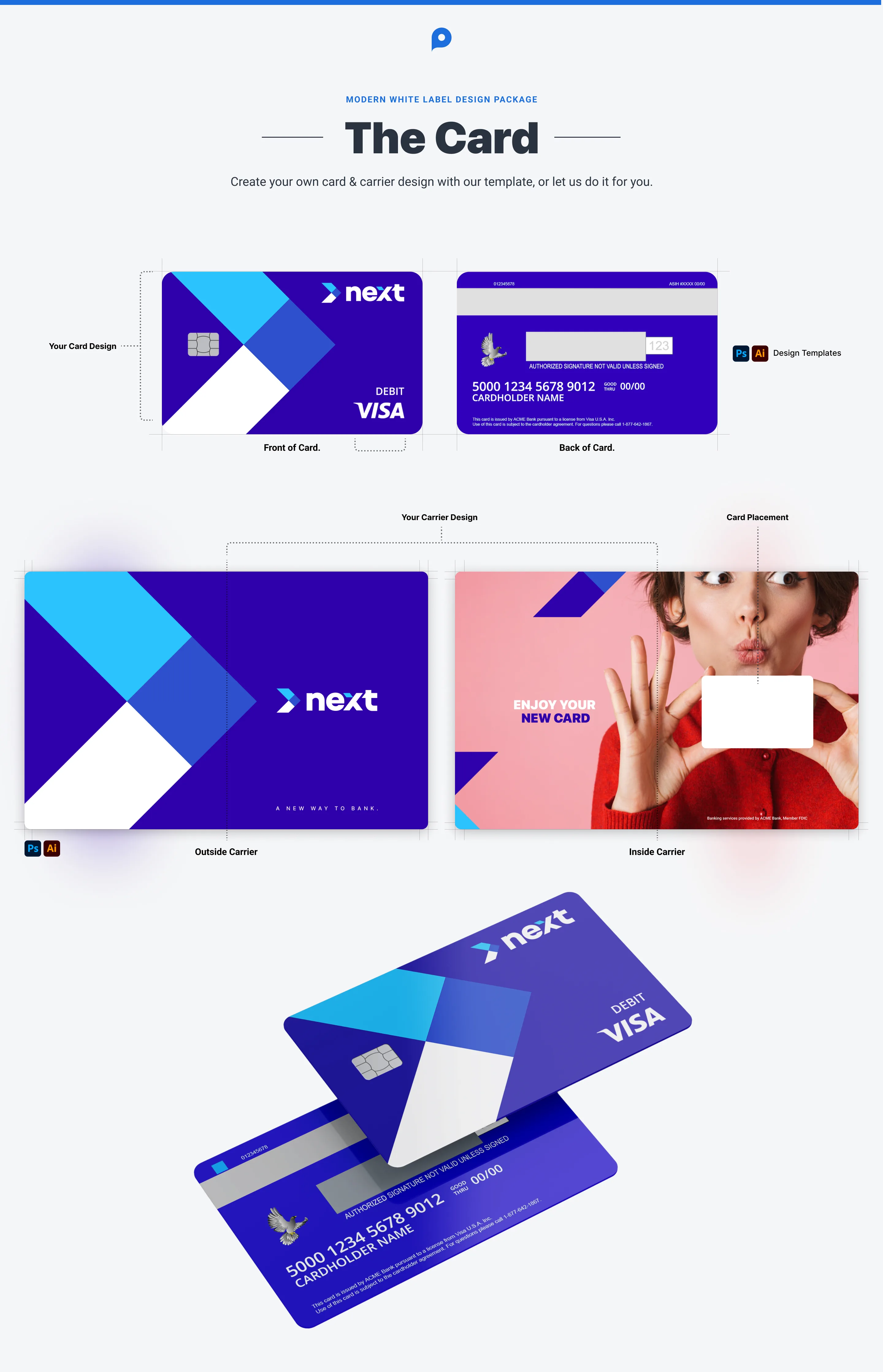
We shipped a white-label design package customers could put their own brand on without filing a design ticket: card templates in Photoshop and Illustrator, carrier and marketing collateral, and a token system that re-skinned every screen automatically when partner colors changed.

Productfy white-label card design package — front, back, carrier templates, and marketing placement assets.
The white-label card package — the system's most-shipped artifact, and the one every sales conversation pivoted on.
(05)The app

The app

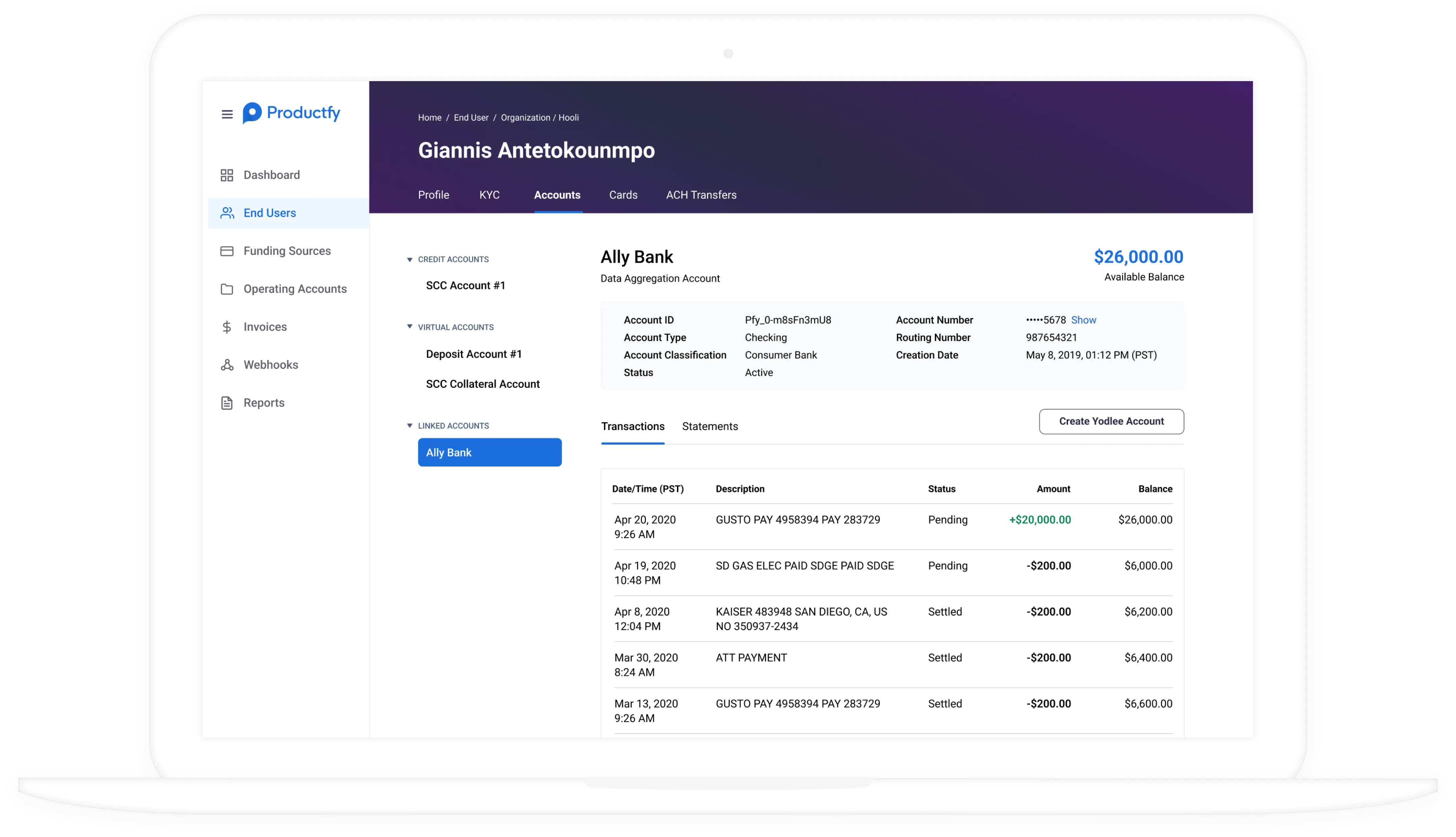
Three surfaces did most of the work, sized to the audience using them. The admin console got the most screen real estate — it's where Productfy's own ops team lived. The reference consumer flows and end-user mobile sit alongside it, each tuned to its own audience.

Productfy admin console — End Users view with profile, KYC, accounts, cards, and ACH transfers tabs.
02 · Admin consoleEnd-user management with full visibility into KYC, linked accounts, virtual accounts, and transaction history — the surface Productfy's ops team operated from every day.
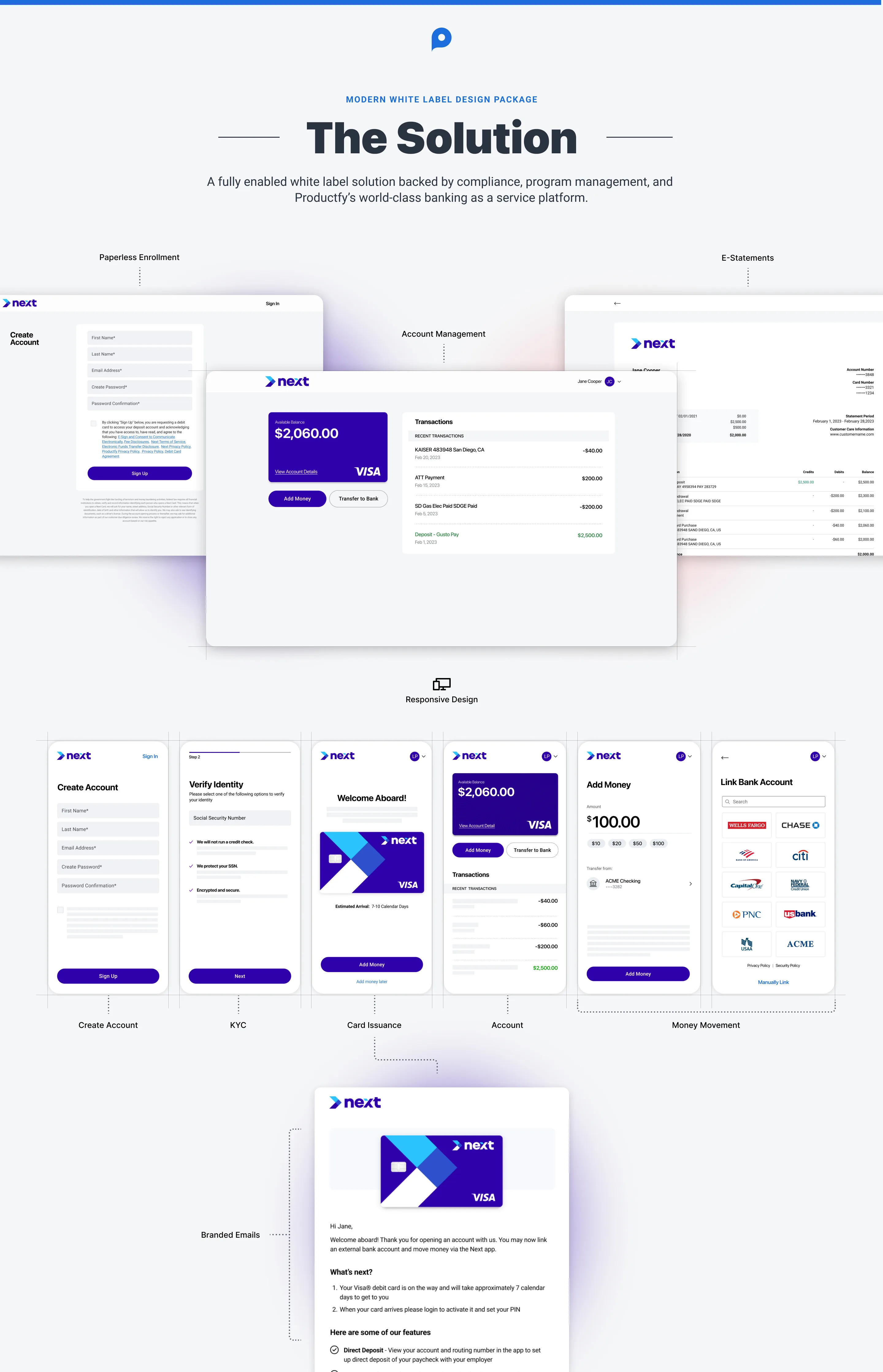
Productfy white-label solution — desktop and mobile flows: enrollment, KYC, card issuance, money movement, branded emails.
03 · White-labelReference consumer flows — paperless enrollment through money movement, all skinnable per partner.
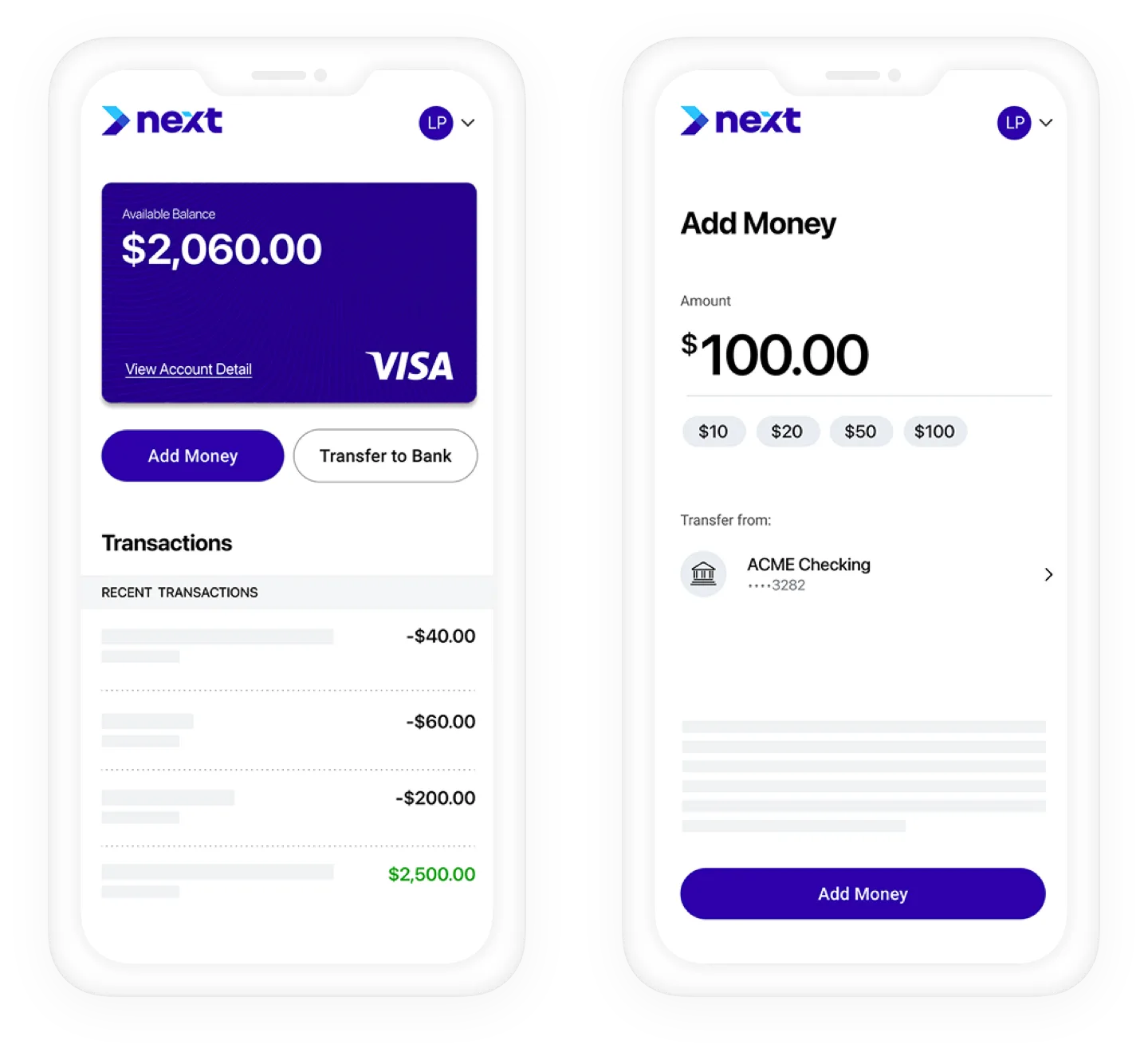
Productfy consumer mobile app — account balance and Add Money flow with quick-add amount chips.
04 · MobileEnd-user account hero, Add Money quick-chips, and a transaction stream tuned for the account-holder.
(06)Outcomes

Outcomes

Headline · Series A$16M

Series A closed in late 2021 with the surfaces we built carrying the story — 500 Global, CM Ventures, Envestnet, and Point72 Ventures on the cap table. Productfy was later acquired by Mastercard.

Time-to-launch on white-label

< 3 weeks

Distinct buyer personas, one surface

3

What went well. The dual narrative landed. The marketing site converted both API-first developers and zero-code partners without splitting the page into two products, and the white-label card package became the artifact every sales conversation pivoted around — the moment a prospect saw their own brand on a card, the conversation moved from "is this possible" to "when can we ship."

Retrospective. BaaS is a regulatory minefield — partner banks moved at their own pace, and a few of the deeper API surfaces (charge-card issuance especially) had to ship in narrower form than we'd originally scoped. The white-label flows held up. The admin console held up. The category caught up around them.

"The card package didn't just sell the product. It taught us how to sell the product."

— Head of growth · Productfy
(07)Engagement

Engagement

Timeline

~10 months

Tier

Embedded

Services

Brand · UX strategy · IA · Design system · Card design · Dev partnership

Outcome surface

Marketing, admin console, white-label, mobile

Next case

Businessfriend →Mobile communication · Social productivity